
Guide
The economic calendar and Bitcoin: how CPI, the Fed decision and the jobs report move crypto
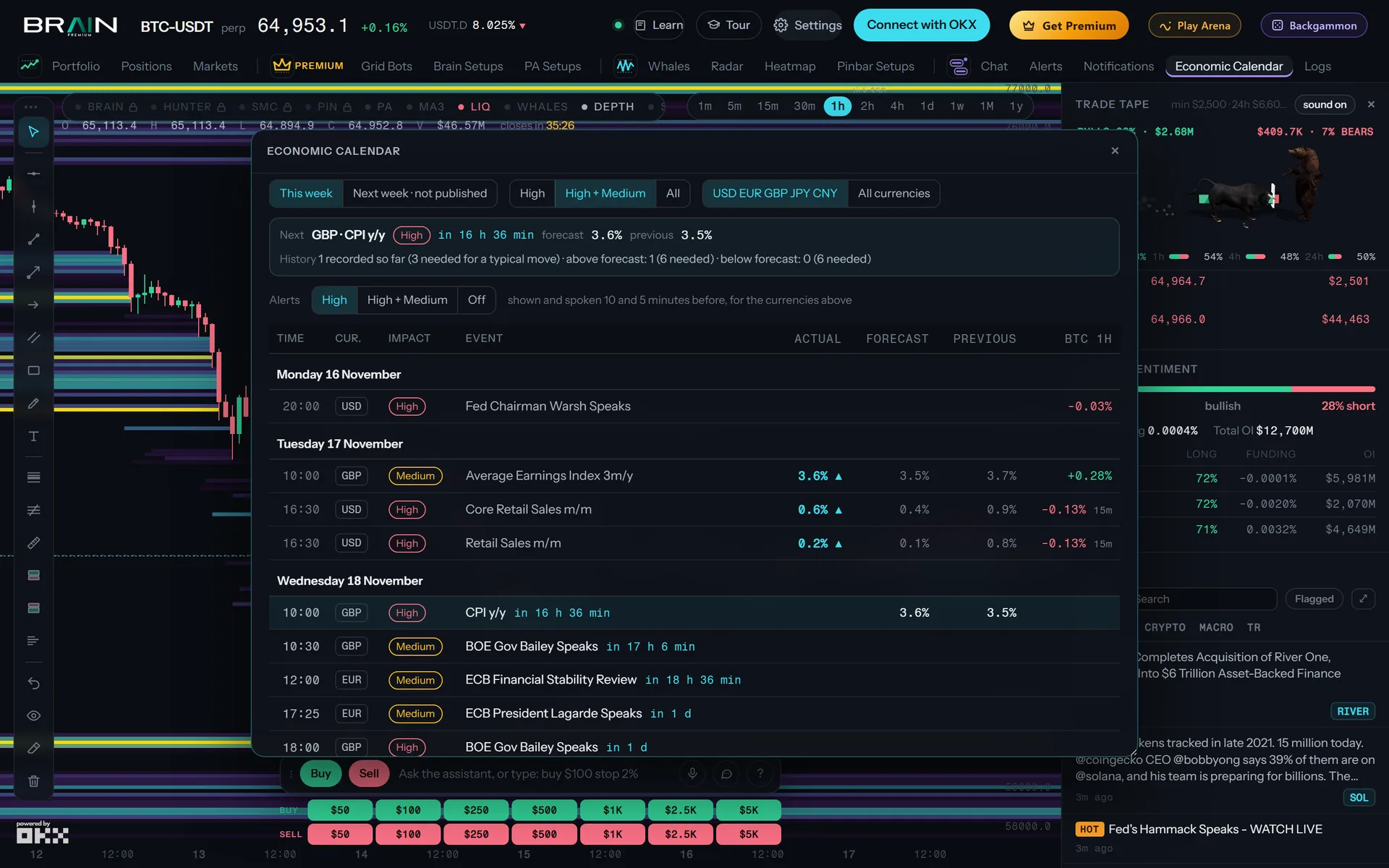
The economic calendar is the list of the days and times at which data such as inflation, rate decisions and employment are released. The crypto market reacts sharply to them, because rate expectations move the dollar and every risky asset together. For Bitcoin the ones watched most are US inflation (CPI), the Fed rate decision and non-farm payrolls. In the BrainPremium terminal the calendar is a window beside the chart: it warns you aloud 10 and 5 minutes before a release and shows the Bitcoin move after it.
This article explains which releases matter, how a release is read and what to watch at the release time.
The releases that move Bitcoin most
| Release | When | Why it matters |
|---|---|---|
| US CPI | Monthly | Inflation is the main number behind the direction of rates |
| Fed rate decision (FOMC) and press conference | Eight meetings a year | The rate and balance-sheet decision, together with the chair's remarks |
| Non-farm payrolls (NFP) | Usually the first Friday of the month | The strength of the labour market |
| Core PCE | Monthly | The inflation measure the Fed watches closely |
| Weekly jobless claims | Every Thursday | An early sign of a sudden change in employment |
The chain of reasoning is this: if inflation comes in high, rates are expected to stay high for longer, the dollar strengthens and risky assets come under pressure. A low number is expected to do the opposite. The market does not always follow that chain; what decides is where the number stands against the forecast.
How to read a release: forecast, previous, actual
- Forecast: the consensus estimate of analysts. The price has largely taken this number in before the release.
- Previous: the value of the period before; it can be revised later.
- Actual: the real number. What makes the move is not the number itself; it is its distance from the forecast.
- Impact: calendars sort releases into high, medium and low impact; the high-impact ones raise volatility in the minute of the release.
What to do at the release time
- Know the time in advance. The most common mistake is to open a position, unaware, a few minutes before a high-impact release.
- Look at your leverage again. In the release minute the price can throw a hard wick both ways; tight stops are hit easily.
- Do not chase the first move. The first reaction is often taken back; the direction becomes clear a few candles later.
- Do not forget the chair's remarks. With a rate decision, the real move often comes in the press conference after it.
These are general habits; none of them says which way a release will take Bitcoin.
The economic calendar in the BrainPremium terminal
In BrainPremium the calendar is not a separate site; it is the Economic Calendar window inside the terminal:
- A weekly table in your local time. Choose only the high-impact releases, high and medium, or all of them; the major currencies or every currency.
- The actual value at once. When a number arrives, an arrow marks whether it came in above or below the forecast; the time to the next release counts down.
- A Bitcoin column. Beside each release stands the Bitcoin move after it. Once enough past releases of the same data are recorded, the typical move is shown too; when there are not enough, the window says so plainly.
- A spoken warning. 10 and 5 minutes before the releases of the impact level you chose, the assistant tells you in writing and aloud.
You can ask by voice: "what is on the calendar today?" or "what did CPI come in at?". The calendar is free.
Frequently asked questions
How does the Fed rate decision affect Bitcoin?
A rate cut, or the expectation of one, is usually taken well by risky assets; a message that rates will stay high is taken badly. But the decision is usually priced in beforehand; what sets the move is how far the decision and the remarks are from what was expected.
What time is US inflation data released?
CPI is usually released at 08:30 US Eastern time; the time where you live shifts with summer and winter time. The BrainPremium calendar shows every time in your own local time.
Should I trade while a number is being released?
That is a personal risk decision. In the release minute volatility and the spread grow, and orders can fill far from the expected price. Many traders prefer to wait out the first minutes until the direction is clear.
Which releases on the economic calendar do not matter for crypto?
Low-impact releases and the data of small economies rarely make a visible move in Bitcoin. Giving your time to the high-impact US releases and the central bank decisions is enough.
Related articles and the terminal
- Bitcoin dominance, USDT.D and TOTAL explained: the traces macro data leaves in crypto.
- How to read a Bitcoin liquidation heatmap: the fuel of the sharp moves at a release.
- The BrainPremium home page: every feature of the terminal, with live screenshots.
Crypto trading involves risk; this article is not investment advice.
Written by the BrainPremium team; our own product is one of the products compared. Competitor facts were read from their own pages on the date given.