
Guide
Order block, BOS, CHoCH and FVG explained: price action terms with clear definitions
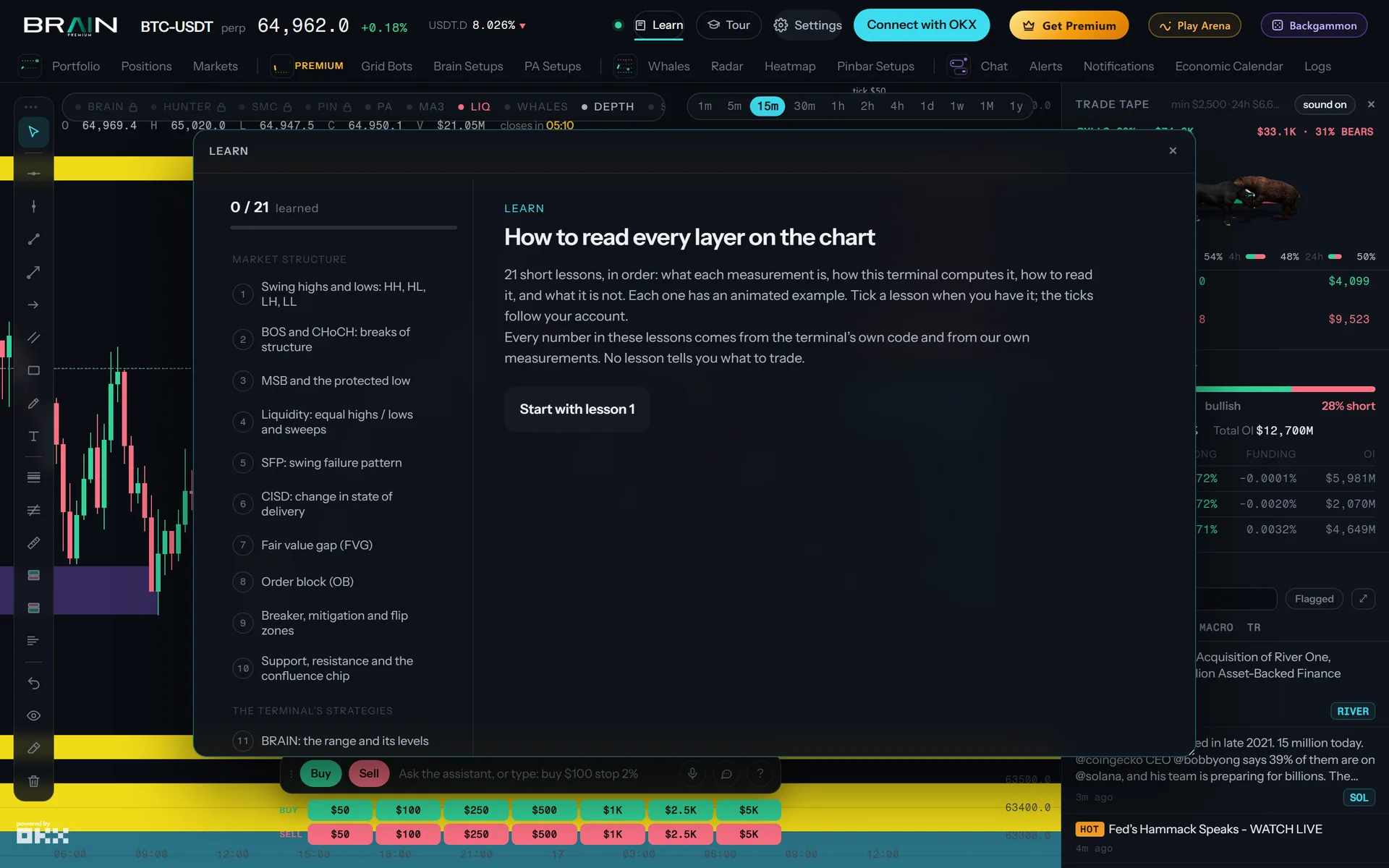
A BOS (break of structure) is a close through a swing high or low in the direction of the trend; a CHoCH (change of character) is the same break against it. An order block (OB) is the last opposite candle at the place where the move that broke structure began. An FVG (fair value gap) is the range left untraded between three candles in a fast move. The BrainPremium terminal draws these on the OKX chart with one definition each and teaches them in a 21-lesson Learn window with animated examples.
In price action and "smart money" (SMC) material the same term is drawn differently from one source to the next. This article gives each term one clear definition.
Market structure: highs, lows, BOS and CHoCH
Everything starts with swings. A rising market makes higher highs (HH) and higher lows (HL); a falling one makes lower highs (LH) and lower lows (LL).
| Term | Definition | What it says |
|---|---|---|
| BOS | A close beyond the last high (the last low in a downtrend), with the trend | The trend continues |
| CHoCH | The first break of the internal structure against the trend | The character may be changing |
| Sweep | A wick through the level with a close back inside | Liquidity was taken, the level stands |
| Equal highs / lows | Highs or lows that gather at one price | Stop orders wait behind them |
The distinction that matters most is the close: when a wick passes a level and the candle closes back inside, that is a sweep, not a break.
What is an order block (OB), and how is it drawn?
An order block is the last opposite candle at the start of the move that broke structure: in an advance, the last down candle at the low the breaking leg began from. The most common mistake is to take a candle in the middle of the move for an order block.
- There must be a strong move behind it. If the leg from the origin to the break was short, that candle is not counted as an order block.
- The first return is the one watched. The moment the price comes back to the block for the first time is what traders wait for; a block weakens with every visit.
- A close through it ends it. Once a candle closes beyond the block, the block has lost its role.
What is an FVG (fair value gap)?
When the price moves very fast, one candle's range does not overlap the range of the candle two before it. In an advance, the zone between the first candle's high and the third candle's low was never traded; that zone is the fair value gap.
- The middle candle that made the gap must have a strong body; small gaps are noise.
- The gap "fills" as the price returns into it; how much of it is filled is what gets tracked.
- A gap that is fully filled has done its work.
- A gap that is filled quickly and closed through shows that the move that made it did not continue.
How does BrainPremium show these structures?
In BrainPremium market structure is a layer on the chart, and everything is computed from the terminal's own candles:
- One definition. A break is the first close through the level; a wick counts as a sweep. The swings that were drawn do not move afterwards.
- Measured drawing. An FVG is drawn only when it is at least one ATR tall, an order block only when the leg behind it travelled at least 1.5 ATR.
- A counter beside the price. It counts, by name, how many measurements (a level, a block, a gap, an equal high or low) sit near the current price. It is a count, not a probability.
- Lessons. Each of the 21 lessons in the Learn window explains a term under four headings: what it is, how the terminal measures it, how to read it, what it is not.
The Learn window is free. The structure layer on the chart and the PA Setups window are part of Premium.
Frequently asked questions
What is the difference between BOS and CHoCH?
Both are a close through a swing level. With the trend it is a BOS and shows the trend continuing; against the trend it is a CHoCH and says the character may be changing. One CHoCH does not mean the trend has turned.
Are an order block and an FVG the same thing?
No. An order block is a candle: the last opposite candle where the move began. An FVG is a gap: a price range that was never traded between three candles. They often sit in the same area, but they are measured separately.
Are these structures buy and sell signals?
No. Order blocks, FVGs and breaks describe the zones where the price may react and the state of the structure; they do not say a trade will win. They are used with your own confirmation, your stop level and your risk plan.
Which timeframe does price action work on?
The definitions are the same on every timeframe. A common method is to take the direction from a higher timeframe (4-hour, daily) and look for the entry on a lower one (15-minute, 1-hour). BrainPremium also shows the trend of the two timeframes above the chart's.
Related articles and the terminal
- How to read a Bitcoin liquidation heatmap: seeing where liquidity has built up.
- How to do Bitcoin technical analysis: support, resistance, RSI and the volume profile.
- The BrainPremium home page: every feature of the terminal, with live screenshots.
Crypto trading involves risk; this article is not investment advice.
Written by the BrainPremium team; our own product is one of the products compared. Competitor facts were read from their own pages on the date given.